
After July 2024 we'd planned the next refreshing of The Mary Hamilton Papers for summer 2025, and when that didn't happen, rescheduled it at several points in late 2025 and early 2026. Each time, some hitch prevented the update from going ahead — until now, but as a result the Hamilton edition has been refreshed much more thoroughly. I'll try to give a flavour of what has changed.
Letters recast
Some letters now look rather different, with separated parts merged into the single letter they originally belonged to. For instance, HAM/1/15/2/7, from Hamilton to Charlotte Margaret Gunning, is no longer missing its last page, which reveals Hamilton's haughty disinclination to accept a potential new correspondent ‘with whom I do not live in the strictest friendship’.1
The whole correspondence between Mary Sharpe and Hamilton is now organised into a single sequence starting at HAM/1/22/1, all transcribed. The early emotional dependence of Sharpe (a wealthy but lonely heiress) on Hamilton and Elizabeth Carter stands in contrast to the bitterness with which she reproaches Hamilton after her friends express disapproval of her marriage (see e.g. HAM/1/22/52). Hamilton isn't one to concede the moral high ground; her ice-cold rejoinder (HAM/1/22/54) concludes thus:
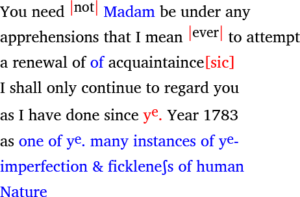
Extract from 1789 letter of Mary Hamilton to Mary Sharpe (later Beauvoir), HAM/1/22/54
Two isolated letters (now HAM/1/18/221, HAM/1/18/222) which were formerly attributed to an unidentified author turn out to be from Louisa Murray, Countess of Mansfield, who organises Louisa Dickenson's presentation at Court on 4 June 1808 while Hamilton herself is incapacitated by gout. The hard-to-read signature had been deciphered as ‘G.H.’ but is more likely to be the initials ‘LG’ for ‘Louisa Greville’, reflecting her second marriage, plus an underlined ‘M’ for ‘Mansfield’.

Louisa Murray's signature in HAM/1/18/221
And as a final example, HAM/1/9/116, previously catalogued as a partial copy of a letter from Dorothy Blosset, has been recast as a letter from Mary Hamilton to her husband on the awkward and urgent task of responding to a note of Blosset's that is pretty much unreadable. Hamilton deputes their young friend Harriet Anne Bandinel to exhibit a sample of Blosset's handwriting for Dickenson, and Bandinel goes on to reveal herself as a witty commentator on the eccentricities of the Dickensons' old friend, Anna Maria Clarke.
Metadata
In previous releases of the edition, metadata such as dates of origin, sending and/or receipt, or the places of sending and/or receipt, often had to be left as unknown or at best rather non-specific. We've been trying to nail down such metadata where we can (and there's more to follow). One contribution to this rather nerdy exercise is a database of residences occupied by Mary Hamilton and her family: their various homes, the houses of friends who offered long periods of hospitality, lodgings taken in London or a spa town. Another is increased recourse to her husband John Dickenson's diaries, as he conveniently tends to list where he's been and who he has encountered. There's a curious lapse in February 1790. Dickenson leaves for London at short notice, for once not taking his diary with him, so it's largely blank for the weeks of his absence, except for a few entries that Mary, at home in Taxal, has filled in for him! Saturday 6 February is certainly by her.
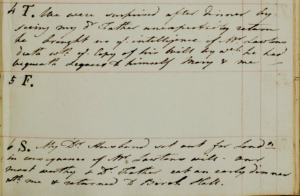
entries 4-6 February 1790 in DDX 274/19 p.183
Metadata for most items includes a summary of the content. When we first created TEI-XML files for our project, we took over the existing summaries in the Library's ELGAR catalogue, many of which have been left untouched ever since. As part of the checking process, I've got to see a number of items that had been assigned to other members of our editorial team, sometimes tidying the wording of a summary, occasionally modifying the interpretation too. A more systematic revision concerns the titles of items, which have a fixed pattern that includes author and, where appropriate, recipient. We have now adjusted titles so that only one form of name is used for each correspondent in the Papers. This would have made revising the ELGAR catalogue enormously burdensome, so there's a script to cycle through all relevant metadata in our TEI-XML files and update the master-file that underlies the catalogue. The result will be checked by the current archivist, Jess Smith, and when posted, the updated library catalogue should be fully harmonised with the online edition and remain so subsequently through further revisions. It's an invaluable finding aid for those items held at Manchester. Another finding aid is our visually updated Excel spreadsheet CurrentFileList, which has essential metadata and hyperlinks to MDC for all 3201 items in The Mary Hamilton Papers.
New transcriptions and AI
Our original hopes for the project ‘Unlocking the Mary Hamilton Papers’ had been to transcribe everything, but what with the time-consuming thoroughness of our editing, the discovery of new items and the demands of research, we didn't achieve that particular objective during the period of the grant (see my blogpost ‘Edition complete!’). Nuria and I have now added well over 100 new transcriptions, some based on work by her students at Vigo, but as we no longer have routine access to student transcribers, we've started using a customised Large Language Model trained exclusively on existing Hamilton transcriptions by Dr Pete Morris of the Rylands (see his blogpost). His LLM offers either diplomatic or normalised plain-text transcriptions. We use the former as our starting point. It saves time by allowing us to concentrate on correcting LLM mistakes and adding TEI mark-up, with both Nuria and me making final checks. There are already some further complete draft transcriptions awaiting a final check from Nuria, and we'll be adding more over the coming months for the next refresh. Nuria, Pete and I are collaborating with a team led by Dr Tanja Säily at Helsinki on assessing the accuracy and utility of what is becoming widely known as HTR (= Handwritten Text Recognition).
Personography
Our personography database records a lot of research used editorially. From a user's point of view,
- It supplies mouseover tooltips for persons mentioned in online transcriptions. Tooltips get updated only when the whole collection is refreshed by the MDC team.
- Most of its data is available in greater detail on the alphabetical Personography page on this website, frequently updated.
Over the last couple of years, hundreds of corrections and revisions have gone into the personography. Where I can, I'm adding date ranges to the AKA (= Also Known As) part of an entry, as that offers instant clues to date of marriage (for women), period of appointment (e.g. of a bishop), date of acquisition of titles, and so on. For the latest refresh, Tom Higgins of the MDC team has kindly added AKAs to the tooltips in the edition, as our canonical names can be rather different from what's in the manuscript. I've also been checking the mark-up of mentions in XML transcriptions; quite a few more persons have been identified for this refresh, and a few slips rectified.
I don't know at the moment what availability Nuria and I will have for continuing the revision processes discussed in this blogpost, but with luck we'll be able to make further improvements and offer another refresh before long. As always, we welcome feedback and suggestions.
Note
1 Incidentally, elsewhere in her correspondence with Gunning, Hamilton employs a previously unnoticed codename, ‘Orion’, for the Prince of Wales (HAM/1/15/2/19 p.3). I leave it to our colleague Sophie to decide if there is a subtext to this choice.
